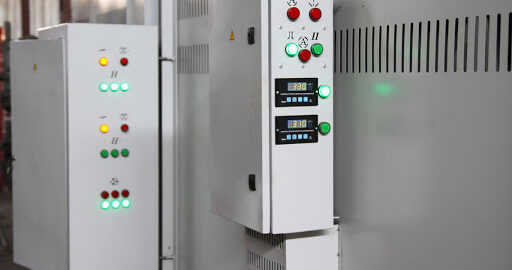
Why do you need a control panel in the polymerization chamber?
Thanks to powder paint, it is possible to create a coating that will last a long time and protect the product from scratches. At the same time, a feature of this type of coating is also the fact that it is resistant to temperature changes. In order for the paint to acquire all its properties, it is very important to maintain the proper functioning of the equipment while converting the powder into polymer film. For one of the most important tasks in the process of creating a coating – polymerization – the control panel of the polymerization chamber is responsible. This is an inseparable element of the painting line, so a little more about why it is indispensable.
The process of creating a coating, which contains several separate stages, requires careful control at each of them. One person simply cannot keep track of every action of several dozen mechanisms and the operations of these often bulky machines. Therefore, it will be advisable to use control panels. One of which is located in the polymerization chamber.
Polymerization furnace
The powder paint polymerization chamber is one of the final elements of the whole process. First, the product must be cleaned of paint residues, oil stains, dust and dirt, or sanding residues. It is worth not to skip this step, the paint should be applied to the bare metal. In the presence of foreign substances or any other elements, the paint may peel off after painting. Or it can do it already during the operation of the product by the client. The next step is the application of paint, its magnetization by the electrostatic method on the surface. This is an interesting process that you just need to see once. Particles of paint in a container acquire one charge, while the product has another. When sprayed from a spray gun under a stream of air, the paint scatters around the product and settles just enough to cover it with one even layer. After that, the product is transported to the polymerization furnace.
A polymerization furnace, or a polymerization chamber, is a special bulky device where a product is placed and heated at high temperatures of 180-220 degrees. This is a special equipment specifically for applying powder paint, and its function is to create a coating by reflow. Powder paint, electrified on the surface, begins to melt at high temperatures. Each grain spreads by itself until the neighboring ones begin to unite and form a continuous film. This film is still liquid, so it wets the surface to a certain extent and this allows it to adhere better to the surface. For some time, which takes no more than 10 minutes, while in the oven, the paint penetrates into all the surface irregularities, is evenly distributed, and the curing process begins.
Polymer ovens are classified as follows:
Depending on the assembly and equipment of the equipment, polymerization furnaces can be dead-end, or through, one-pass, multi-pass, vertical and horizontal. Their difference lies in where the product will be transported inside the oven and outside.
Depending on what kind of fuel will be used to ensure the presence of high temperature, they are distinguished: electric and fuel, operating on oil products.
By type of heating there are: thermo-radiation, convective, induction and combined ovens. Convection ovens are considered the most common. Air masses are heated in them, which then heat the powder. Such a furnace must contain an air duct, a heat and ventilation center, a ventilation mechanism, and a combustion chamber. Thermo-radiation furnaces operate on the basis of infrared radiation, induction furnaces are used at the beginning of the heating stage, and combined ones allow combining heating and drying processes.
However, no matter how special the polymerization oven is, it still has one indispensable element – a device for automatic temperature control and process regulation.
These devices are installed inside the polymerization chamber. They regulate the processes using an integrated software module with climate sensors. Thanks to this, the program monitors the temperature processes and chemical reactions that occur inside the chamber and are not accessible to the person in charge of the process.
The main functions of the control panel:
- maintain a constant temperature specified for a given coloring process.
Any deviations in temperature will affect the baking and curing quality of the paint. They can cause faulty surface defects.
- monitor voltage drops
- monitor the amount of fuel supplied to the combustion chamber, or the degree of heating. The uniformity of prolonged heating and the maintenance of a constant temperature depend on this.
- control over the proper functioning of the ventilation device.
As a separate link in a complete process, this device greatly simplifies the work. But its importance is precisely in controlling the quality of the further product, because how good the result will be depends on how the polymerization is performed.